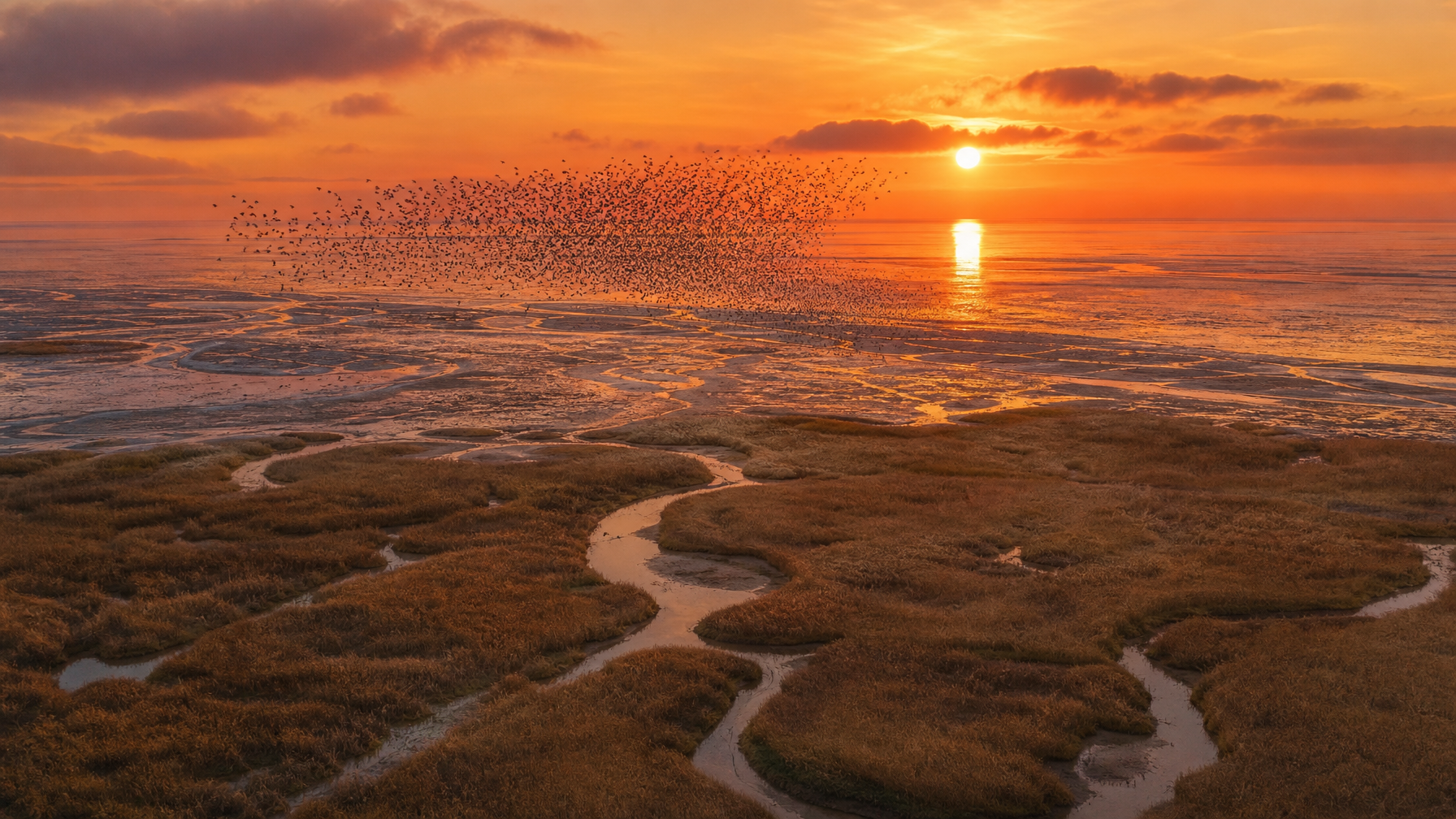
The East Atlantic Flyway: Why North Norfolk Sits at the Heart of One of the World’s Great Bird Migrations
TLDR: Every year, roughly 90 million birds travel the East Atlantic Flyway — a global migration corridor stretching from the Arctic to the southern tip of Africa. North Norfolk’s coastline is one of its most critical refuelling stops: a stretch of saltmarsh, mudflat, and tidal lagoon that keeps millions of birds alive on journeys of thousands of miles. If you’ve ever stood on the North Norfolk coast and felt that the landscape was doing something much bigger than you could quite explain, this is why.
—
Table of Contents
– What is the East Atlantic Flyway?
– Why North Norfolk?
– RSPB Snettisham: The Flyway’s Greatest Show
– RSPB Titchwell Marsh: The Flyway’s Most Welcoming Reserve
– Holme-next-the-Sea: Where the Flyway Makes Landfall
– The Seasonal Migration Calendar
– Species to Watch on the North Norfolk Flyway
– The Bigger Picture: A Landscape Worth Protecting
– Your Base for the East Atlantic Flyway
– FAQs
—
What is the East Atlantic Flyway?
Think of it as a motorway in the sky — a route followed by tens of millions of birds every spring and autumn as they move between their Arctic breeding grounds and their African wintering sites.
There are nine major flyways around the world. The East Atlantic Flyway is one of the most heavily used, funnelling birds southward from Siberia, Canada, Iceland, and Scandinavia, along the Atlantic coastline of Western Europe, through the estuaries and mudflats of Britain and France, and down to West Africa.
According to the RSPB, an estimated 90 million birds use this route each year. Each summer, the Arctic briefly transforms into a fertile breeding ground — hosting 200 species and up to 500 million individual birds. When the Arctic winter returns, those birds need to move, fast. The East Atlantic Flyway is the route they take.
The warming influence of the Gulf Stream keeps Britain’s mudflats and saltmarshes open when wetlands further north freeze over. That makes England’s east coast not a pleasant optional stop on the journey — it is, for many species, the difference between life and death.
From the Humber estuary down to the Thames, England’s east coast hosts nine sites that regularly support more than 100,000 migrating birds. The Wash alone acts as a winter home for nearly half a million. In 2023, the UK government added England’s east coast wetlands — a 1,700 square kilometre arc of habitat — to its Tentative List for UNESCO World Heritage status, recognising the area as a globally irreplaceable asset. Source: Geographical Magazine
North Norfolk sits at the northern gateway of that arc.
—
Why North Norfolk?
A handful of factors combine to make North Norfolk one of the most important stretches of the entire flyway.
Geography. The North Norfolk coast juts eastward into the North Sea, putting it directly in the path of birds crossing from Scandinavia. Many species — arriving exhausted after a sea crossing — make landfall here first.
Habitat diversity. The coast offers saltmarsh, tidal mudflats, freshwater lagoons, reedbeds, shingle spits, sand dunes, and open grazing marsh in close proximity. Different species need different habitats. North Norfolk delivers all of them within a few miles.
The Wash. The great bay between Norfolk and Lincolnshire is one of the largest estuaries in Britain, covering around 625 square kilometres of tidal mudflat. It is nutrient-rich, teeming with the invertebrates — cockles, shrimps, worms, small crustaceans — that wading birds depend on to rebuild their fat reserves before continuing their journeys.
Scale. 29 bird species use England’s east coast wetlands in internationally important numbers. Norfolk Wildlife Trust’s Holme Bird Observatory near Hunstanton has recorded 320 different species across its patch alone — a number that reflects not just the range of species on the flyway but the quality of the habitat here that draws them in.
David Attenborough placed Cley Marshes — a Norfolk Wildlife Trust reserve just along the coast — among his personal top ten places to see nature in the world, alongside Antarctica and the Galápagos.
—
RSPB Snettisham: The Flyway’s Greatest Show
If you visit one birdwatching event in your life in North Norfolk, UK, make it this one.
RSPB Snettisham sits on the southern shore of the North Norfolk coast where the land curves inward to meet The Wash — Britain’s largest estuary. The reserve has panoramic views across saline lagoons, open saltmarsh, shingle banks, and the vast tidal mudflats that stretch far out into the bay. At low tide, those mudflats are alive. Cockles, shrimps, lugworms, and small crustaceans lie just beneath the surface in extraordinary densities. For a wading bird that has just crossed the Arctic Ocean, this is not just food. It is survival.
The Wash holds around 40% of the entire UK wintering population of knot — a statistic that makes Snettisham one of the most important single sites on the East Atlantic Flyway anywhere in Western Europe.
The Snettisham Spectacular
On the highest tides of the year, the incoming sea covers those mudflats completely. The knot that have been feeding out on the flats — tens of thousands of them, sometimes more than a hundred thousand at peak season — are pushed off their feeding ground. They have nowhere to go but up.
What happens next is genuinely difficult to describe. The entire flock rises simultaneously and forms a vast, shape-shifting mass in the sky. It twists, contracts, expands, and turns against the light — the whole flock moving as a single organism. The RSPB calls it the ‘whirling wader spectacle.’ Photographers talk about it for years afterwards. People who have never been birdwatchers in their lives leave Snettisham changed.
The Spectacular is not a scheduled event. It is entirely dictated by the tides. The RSPB publishes a guide to the highest tides each year — check the RSPB Snettisham events calendar for confirmed dates and times. The Spectacular tends to peak in the autumn and winter months (September through February) when the largest knot populations are present.
What Snettisham Offers Outside Spectacular Season
The reserve is worth visiting any time of year. In spring and summer, avocets, redshanks, and lapwings breed on the lagoon islands. Oystercatchers nest on the shingle banks. Little terns prospect the beach. In autumn, enormous skeins of pink-footed geese arrive from Iceland, filling the sky above the Wash in formations that can stretch for miles. In winter, short-eared owls quarter the marsh at dusk and hen harriers roost on the reserve.
The address is Beach Road, Snettisham, King’s Lynn PE31 7RA.
The History Beneath the Lagoons
There is one more layer to Snettisham that most visitors never know — and it involves the very water the knot stand in. The lagoons exist because of what happened on this foreshore during the Second World War, and it is one of the most unexpected origin stories in British conservation. Read the full Camp 255 history.
Walking to Snettisham from mYminiBreak
From the mYminiBreak Hunstanton and Heacham site, guests can walk directly to RSPB Snettisham along the King Charles III England Coast Path — entirely on foot, no car needed. The route passes through the Wild Ken Hill rewilding project (the BBC Springwatch filming location that borders the site), along the shingle foreshore, and straight to the reserve: rewilding, wartime history, and world-class birdwatching on a single coastal path. Full Snettisham walking guide.
—
RSPB Titchwell Marsh: The Flyway’s Most Welcoming Reserve
Ask any birdwatcher in Britain to name their single favourite reserve, and Titchwell Marsh appears more often than almost anywhere else. It sits between the villages of Titchwell and Thornham on the North Norfolk coast, directly on the East Atlantic Flyway, and it has been delivering extraordinary wildlife experiences for fifty years.
The reserve celebrated its fiftieth year of conservation in 2023 — half a century during which it has transformed from a stretch of grazing marsh into one of the most finely managed wildlife habitats in Britain. The RSPB’s work here has created a mosaic of habitat types in close proximity: freshwater lagoon, brackish lagoon, reedbed, saltmarsh, and a wide sandy beach with open views across The Wash. Different species need different conditions. Titchwell offers all of them within a short walk.
The Habitats and What Lives in Them
The freshwater lagoon is where avocets breed. These are the RSPB’s emblem species — elegant, black-and-white, with an upswept bill they sweep through shallow water to catch invertebrates. Titchwell is one of Britain’s most reliable sites to see them at close range, and they are present from spring through to autumn.
The reedbeds hold bitterns. The bittern is one of Britain’s most secretive birds — a large, brown, heron-like creature that freezes with its bill pointed skyward when disturbed, perfectly camouflaged against the reeds. Titchwell has worked hard to create the right reedbed structure and water levels to hold a resident bittern population. In winter, when water levels drop and the birds move to the reedbed edges, your chances of a sighting improve significantly.
Bearded tits — small, warm-orange, improbably delicate-looking birds — live year-round in the reedbeds and are best seen on calm autumn mornings when they move in small parties through the reed stems. In winter, they sometimes appear on the reedbed edges in reasonable numbers.
Marsh harriers quarter the reserve in long, lazy glides — buoyant, V-shaped flight low over the reeds. They breed here and are present throughout the year. In winter, short-eared owls sometimes join them over the marsh at dusk.
The brackish lagoon attracts waders on migration. In late summer, this is where you find curlew sandpipers, little stints, spotted redshanks, and — if you are lucky — rarer American waders that have drifted across the Atlantic on autumn weather systems. Titchwell’s position on the flyway makes it one of the best sites in Britain for these mid-autumn surprises.
The beach at Titchwell is a wide, sandy bay with extensive views west across The Wash toward the Lincolnshire coast. In winter, red-throated divers, common scoter, and long-tailed ducks rest just offshore. At any tide, oystercatchers and grey plovers work the tideline.
The Reserve in Practice
The boardwalks and footpaths at Titchwell are designed for close viewing, and the hides are positioned at water level — you look across the lagoon surface rather than down onto it, which makes a real difference to the quality of the sightings. The reserve keeps a daily log of sightings at the visitor centre, so you can find out exactly what has been seen and where before you set out.
Guided tours here offer a genuine guarantee: you can realistically expect to see 50 species in a single visit. For a first-time birdwatcher, Titchwell is one of the most accessible introductions to the hobby in Britain. For an experienced birder, it is consistently productive in every season.
The visitor centre has a well-stocked shop and a café with a wildlife garden that attracts birds to feeding stations just outside the window. It is the kind of place where you arrive planning to stay an hour and leave four hours later wondering where the time went.
The address is Main Road, Titchwell, King’s Lynn PE31 8BB.
—
Holme-next-the-Sea: Where the Flyway Makes Landfall
There is a moment, standing on the beach at Holme-next-the-Sea, where you can feel how old this place is. The saltmarsh stretches east, the dunes fold the wind, and the tide comes in exactly as it has come in for thousands of years. The birds arriving overhead from Scandinavia have no idea they have just crossed an international border. They know only that this is land, after the sea, and that there is food here.
Holme-next-the-Sea sits at the very western corner of the North Norfolk coast, precisely at the point where The Wash meets the open North Sea. For migratory birds crossing from Scandinavia, it is often the first land they reach. That single geographical fact makes Holme one of the most important migration watchpoints in Britain.
A Name 1,200 Years in the Making
The village name is itself a piece of history — brought to this coast by Viking settlers during the Danelaw and unchanged for over a millennium. The etymology tells a story that runs from the ninth century back to the Bronze Age, and the beach here carries physical evidence of all of it. Read the full Holme place name and Seahenge story.
Holme Dunes National Nature Reserve
The Holme Dunes National Nature Reserve covers 500 acres of dune, grazing marsh, freshwater pools, and saltmarsh. It is managed by the Norfolk Wildlife Trust and has three birdwatching hides overlooking the grazing marsh and pools, with disabled access to the first hide. A visitor centre at Broadwater Road, Hunstanton PE36 6LQ has displays on the reserve’s habitats and wildlife, with refreshments available.
The Norfolk Wildlife Trust’s Holme Bird Observatory has monitored migration here for decades and has recorded 320 different species — more than almost any comparable patch in Britain, and a direct reflection of Holme’s position as a first landfall site on the flyway.
The First Landfall Effect
In autumn, when northerly and north-easterly winds push tired birds south across the North Sea, Holme receives what birders call a ‘fall.’ Warblers, flycatchers, redstarts, and chats — small birds that are close to the limit of their fuel reserves after an overnight sea crossing — drop into the dune slacks and scrub, sometimes in extraordinary numbers. A Holme fall in October is one of the genuine spectacles of British birdwatching: the bushes suddenly alive with birds that weren’t there an hour ago.
In spring, the reverse migration brings birds moving northward to their breeding grounds. Wheatears — crisp, clean, with a distinctive white rump — appear on the beach in March. Warblers filter through the scrub in April and May. Waders refuel in the pools and saltmarsh before crossing back over the North Sea toward Scandinavia.
Beyond the Wildlife
The beach at Holme carries a second story running underneath the birdwatching one. A second Bronze Age timber circle — Holme II, a contemporary of Seahenge dated to 2049 BC — remains in situ on this foreshore to this day. The King Charles III England Coast Path passes directly over that same beach, and guests at the mYminiBreak Holme site can walk it from the pitch. The full history of Seahenge, Holme II, and the Viking origins of the village name is here.
The address for Holme Dunes NNR visitor centre is Broadwater Road, Hunstanton PE36 6LQ.
—
The Seasonal Migration Calendar
The flyway is not a single event — it is a continuous cycle. North Norfolk offers something genuinely significant in every month of the year.
| Season | What’s Happening | Key Species |
|---|---|---|
| Late March – May | Spring northward migration. Waders and wildfowl refuel before crossing the North Sea. | Knot, dunlin, sanderling, bar-tailed godwit, wheatear, chiffchaff |
| May – July | Breeding season. Summer visitors raise young on reserves and coastline. | Avocet, marsh harrier, bearded tit, terns at Blakeney Point |
| August – October | Autumn southward migration begins. Returning Arctic breeders move through. Rarities appear. | Curlew sandpiper, little stint, yellow-browed warbler, spotted flycatcher |
| September – February | Winter. The Wash fills with wintering waders and wildfowl. Snettisham Spectacular tides. | Knot, pink-footed goose, dark-bellied brent goose, wigeon, shelduck, short-eared owl |
| November – February | Wildfowl peak. Skeins of geese fill the sky at dawn and dusk. | Pink-footed goose, Bewick’s swan, white-fronted goose |
The broad point: whenever you visit, something is moving through North Norfolk on its way to somewhere extraordinary.
—
Species to Watch on the North Norfolk Flyway
Knot
The most iconic flyway species in North Norfolk. Small, compact, and deceptively tough — knot breed in the high Arctic and can fly non-stop for thousands of miles. In winter, their brick-red summer plumage fades to pale grey, and they arrive at the Wash in enormous flocks that perform the aerial displays at Snettisham. Population: the Wash holds around 40% of the entire UK winter population.
Avocet
Britain’s most elegant wader, and the RSPB’s emblem. Black and white, with an upswept bill it sweeps through the water to catch small invertebrates. Breeds at Titchwell and moves through in migration. Their return to breed in Britain from near-extinction in the 20th century is one of the great conservation success stories.
Pink-Footed Goose
In autumn, huge skeins of pink-footed geese fly in from Iceland and Greenland to winter in East Anglia. Tens of thousands arrive on the Norfolk coast, and the noise and sight of a dawn flight of geese over the saltmarsh is one of the great sounds of a Norfolk winter.
Marsh Harrier
Britain’s most numerous harrier, and one that has recovered dramatically in recent decades thanks to reedbed conservation. Titchwell and Holkham are reliable spots. Watch for their distinctive buoyant, V-shaped glide as they quarter the reedbeds.
Curlew
Britain’s largest wader, with a long, downcurved bill and one of the most evocative calls in nature — a rising, bubbling cry that seems to belong to the landscape itself. Declining nationally, but still present in significant numbers on the North Norfolk coast in winter.
Snow Bunting
A winter visitor from the high Arctic — small, white-flecked, and perfectly camouflaged against snowy dunes. They arrive on the North Norfolk coast in October and work their way along the shoreline in small flocks. The beach at Holme and the dunes at Holkham are reliable spots.
Spoonbill
Once extinct as a breeding bird in Britain, spoonbills now regularly appear along the North Norfolk coast, particularly at Titchwell. They feed in shallow lagoons, swinging their flattened spatulate bills from side to side through the water. A genuinely prehistoric-looking bird.
—
The Bigger Picture: A Landscape Worth Protecting
The East Atlantic Flyway is under pressure. Globally, human development has destroyed 1,000 square kilometres of estuarine habitat over the last 35 years. Britain’s own wetlands were largely drained for agriculture over centuries, and the fragments that remain — the Wash, the North Norfolk coast, the estuaries of Suffolk and Essex — carry a disproportionate share of the burden of the entire flyway.
‘These are arguably one of our most important habitats, not just within the UK, but globally,’ says Julianne Evans, Head of Ecology at the RSPB. ‘We really, really can’t afford to let them go through oversight or through lack of attention.’ [Source: Geographical Magazine]
England’s east coast wetlands are currently on the UNESCO World Heritage Tentative List — a recognition that these saltmarshes and mudflats belong in the same category as the Galápagos. Beyond their wildlife value, they store an estimated 12 million tonnes of carbon in the top metre of soil alone, and serve as a critical natural defence against coastal flooding for the communities behind them.
Visiting North Norfolk and seeing this landscape with your own eyes is, in itself, a meaningful act. The wildlife tourism that brings people to reserves like Snettisham and Titchwell directly funds the conservation work that keeps those reserves going.
—
Your Base for the East Atlantic Flyway
mYminiBreak’s sites in the Hunstanton, Holme, and Heacham area place you within walking distance of the flyway itself.
From the Hunstanton/Heacham site, guests walk directly to RSPB Snettisham along the King Charles III England Coast Path — through the Wild Ken Hill rewilding project, past the historic site of Camp 255, and straight to the lagoons where the Spectacular takes place. No car. Just a walk from the pitch to one of Britain’s most astonishing wildlife events. [Explore the Snettisham coastal walk](/wildlife/snettisham).
The Holme site sits on the doorstep of Holme Dunes National Nature Reserve and the King Charles III England Coast Path. Explore the Holme site.
RSPB Titchwell Marsh is a short drive east along the coast road — one of the most reliably spectacular reserves in Britain at any time of year.
For a birdwatching break that takes the flyway seriously, North Norfolk is not just a good option. It is one of the right answers. Explore birdwatching from mYminiBreak.
Stay over. Make it a miniBreak.
—
FAQs
What is the East Atlantic Flyway?
The East Atlantic Flyway is one of nine major bird migration routes around the world. It carries an estimated 90 million birds annually between their Arctic breeding grounds and their West African wintering sites, running along the Atlantic coastline of Western Europe. England’s east coast — including North Norfolk — is one of its most critical refuelling stops.
When is the best time to see migratory birds in North Norfolk?
There is no wrong time. Spring migration (March to May) brings waders and passerines moving north. Autumn (August to October) is the peak for variety, including rare migrants. Winter (November to February) brings the largest concentrations of wildfowl and wading birds, including the Snettisham Spectacular tidal events. Each season offers something genuinely different.
What is the Snettisham Spectacular?
The Snettisham Spectacular is the name given to the tidal events at RSPB Snettisham on the Wash, when incoming high tides push tens of thousands of roosting knot off the mudflats and into the sky simultaneously. The birds form vast, shape-shifting aerial formations. It is one of the most extraordinary wildlife events in Britain. The RSPB publishes a guide to the highest tides — check their website for Spectacular dates.
Which North Norfolk reserves are best for flyway watching?
RSPB Snettisham (Wash mudflats, knot flocks), RSPB Titchwell Marsh (accessible lagoons, diverse species), Holme Dunes NNR (first landfall for migrating birds), Holkham National Nature Reserve (pink-footed geese, marsh harrier), and Cley Marshes NWT (flagship UK reserve, 430 acres) are the standout sites.
Can I walk to any reserves from a mYminiBreak site?
Yes. From the Hunstanton/Heacham site, you can walk the King Charles III England Coast Path directly to RSPB Snettisham. From the Holme site, Holme Dunes National Nature Reserve is on the doorstep. RSPB Titchwell is a short drive along the coast road from both sites.
Is North Norfolk good for birdwatching beginners?
Absolutely. The reserves here — particularly Titchwell and Cley — have boardwalks, excellent hides, and visitor centres staffed by knowledgeable wardens. Guided tours are available at Titchwell where you can realistically see 50 species in a single visit. The species diversity and the quality of viewing infrastructure make North Norfolk one of the best places in Britain to start birdwatching.
—
mYminiBreak offers dog-friendly glamping, camping, shepherd huts, and cottage stays in the Hunstanton, Holme-next-the-Sea, and Holt area of North Norfolk, UK — ideally placed for the East Atlantic Flyway. Explore your base at myminibreak.com.
Leave a Reply