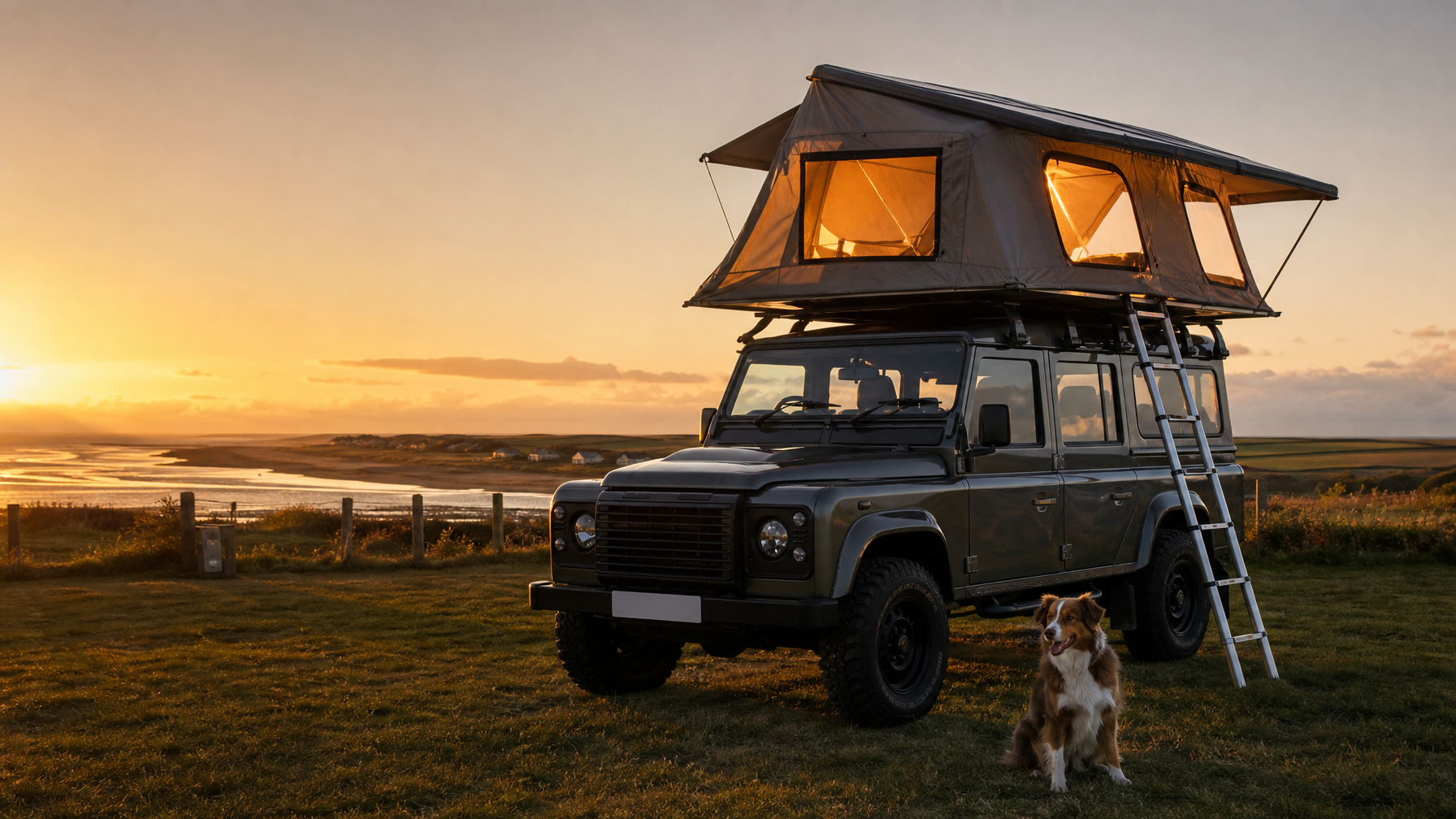
A roof tent mounts directly to your car’s roof rack and gives you an elevated, all-weather sleeping platform with a built-in mattress — no searching for flat ground, no tent pegs, no damp groundsheet. Set up takes as little as 60 seconds with a hardshell model. The one rule every first-timer learns the hard way: always close the tent before you move the car. Always.
Roof tent camping is one of the fastest-growing corners of the UK camping scene — and for good reason. You arrive at a site, press a button or undo a couple of straps, and two minutes later you are sitting four feet off the ground with a better view than anyone in the field below you. The mattress is already in there. The ladder is already attached. The only thing standing between you and a perfect night’s sleep is the small matter of not driving off with the thing still open. More on that shortly.
Whether you are a complete beginner wondering what all the fuss is about, or someone who has just bought their first roof tent and wants to know the things nobody tells you before your first trip, this guide covers everything — types, setup, the mistakes, the kit, the dog question, and where to pitch up in North Norfolk, UK.
What Is a Roof Tent?
A roof tent — also called a rooftop tent, car top tent, or roofbox tent — is a self-contained sleeping unit that mounts to your car’s existing roof bars or roof rack. It comes with a built-in mattress, opening windows with mosquito mesh, a fitted ladder, and weatherproof fabric sides. When closed, it sits flush on the roof like an oversized box. When open, it becomes a comfortable, elevated bedroom with views your ground-tent neighbours can only dream about.
They became popular in overlanding and 4×4 culture — the kind of camping where you drive a Land Cruiser through Namibia and sleep on the roof to avoid the wildlife. In the UK in 2026, you are just as likely to see one on a Golf estate in a Norfolk campsite as you are on a pickup truck in the Scottish Highlands. The concept crossed over from adventure camping into mainstream family camping, and it is not hard to see why.
Hardshell vs Softshell: Which Roof Tent Is Right for You?
Every roof tent is either a hardshell or a softshell. This is the most important decision you make when buying one, and the choice comes down to how you travel and how much you want to spend.
Hardshell Roof Tents
A hardshell tent has a rigid outer shell — usually fibreglass or aluminium — that hinges open like a clamshell. The fabric sleeping area pops up automatically when you release the latches. Setup: approximately 60 seconds. The closed profile is lower and cleaner on the roof, which means less wind noise and slightly better fuel economy on the road.
- Setup time: 30–90 seconds
- Best for: frequent travellers, solo campers, couples who want maximum convenience
- Price range: £800–£3,000+
- Weight: typically 40–65kg
- Sleeping: usually 2 adults
Softshell Roof Tents
A softshell tent unfolds outward from a folded base — the fabric sides, windows, and rainfly all fold out and clip into place by hand. More space when open, more affordable to buy, but slower to set up and pack away (typically 5–15 minutes each way).
- Setup time: 5–15 minutes
- Best for: families, those who stay at one pitch for multiple nights, budget-conscious buyers
- Price range: £400–£1,500
- Weight: typically 30–55kg
- Sleeping: 2–4 adults depending on model
| Feature | Hardshell | Softshell |
|---|---|---|
| Setup time | 60 seconds | 5–15 minutes |
| Price | £800–£3,000+ | £400–£1,500 |
| Road profile (closed) | Low — cleaner aerodynamics | Higher — more wind drag |
| Interior space | Compact but comfortable | More spacious |
| Weather protection | Excellent | Very good |
| Best for | Regular travellers, convenience | Families, budget buyers, base camping |
Which Cars Can Use a Roof Tent?
Most cars can carry a roof tent — but you must check two things before you buy:
1. Roof Bars
Your car needs roof bars or a roof rack capable of taking the tent’s weight. Most factory-fit roof bars are rated for around 75–100kg dynamic load (while the car is moving). Aftermarket roof racks rated for higher loads are available and often recommended for heavier tents.
2. Static vs Dynamic Load Rating
Your car has two separate roof ratings — the dynamic load (weight it can carry while driving) and the static load (weight it can hold while stationary). The tent itself must be within the dynamic rating. The tent plus two sleeping adults must be within the static rating. Check your car handbook for both figures. Most SUVs have a static rating of 300–600kg, which comfortably accommodates two adults plus a tent.
| Vehicle Type | Roof Tent Suitability | Notes |
|---|---|---|
| SUVs — Land Rover Defender, Toyota RAV4, Nissan Qashqai, Ford Kuga | Excellent | Most popular choice, high roof clearance |
| 4×4 pickups — Ford Ranger, Toyota Hilux | Excellent | Adventure-ready, great gear storage |
| Estate cars — Volvo V60/V90, Skoda Octavia, VW Passat | Very good | Good load ratings, practical setup |
| Large hatchbacks — VW Golf, Ford Focus | Good (lighter tents) | Check dynamic rating carefully |
| Small city cars | Not recommended | Low roof ratings, insufficient clearance |
| Campervans and vans | Excellent | Roof racks very common, ideal base platform |
How to Set Up a Roof Tent: Step by Step
Before You Leave Home
Practice your setup in the driveway before your first trip. Every model is slightly different and the first time always takes three times longer than it should. An empty Sunday afternoon at home beats a frantic arrival on a Norfolk campsite at 8pm in the rain.
At the Campsite
- Park on level ground. Even a slight slope makes sleeping uncomfortable. Most campsites will let you move if your first pitch is on a slope — just ask on arrival.
- Unlock the tent. Release the travel straps or turn the latches — every model is different. Refer to your manual.
- Open the tent. Hardshell: lift the rear panel — the gas struts do the rest. Softshell: unfold the panels, extend the support arms, and clip the flysheet into position.
- Extend the ladder. Slide the aluminium ladder down until it locks in place on the ground. On uneven terrain, a small rubber mat under the feet stops it sinking or slipping.
- Open the windows. Mesh ventilation prevents condensation overnight — important in the UK’s damp climate.
- You are done. Climb up, close the tent behind you, and enjoy the view.
⚠️ The Golden Rule — Read This Before Anything Else
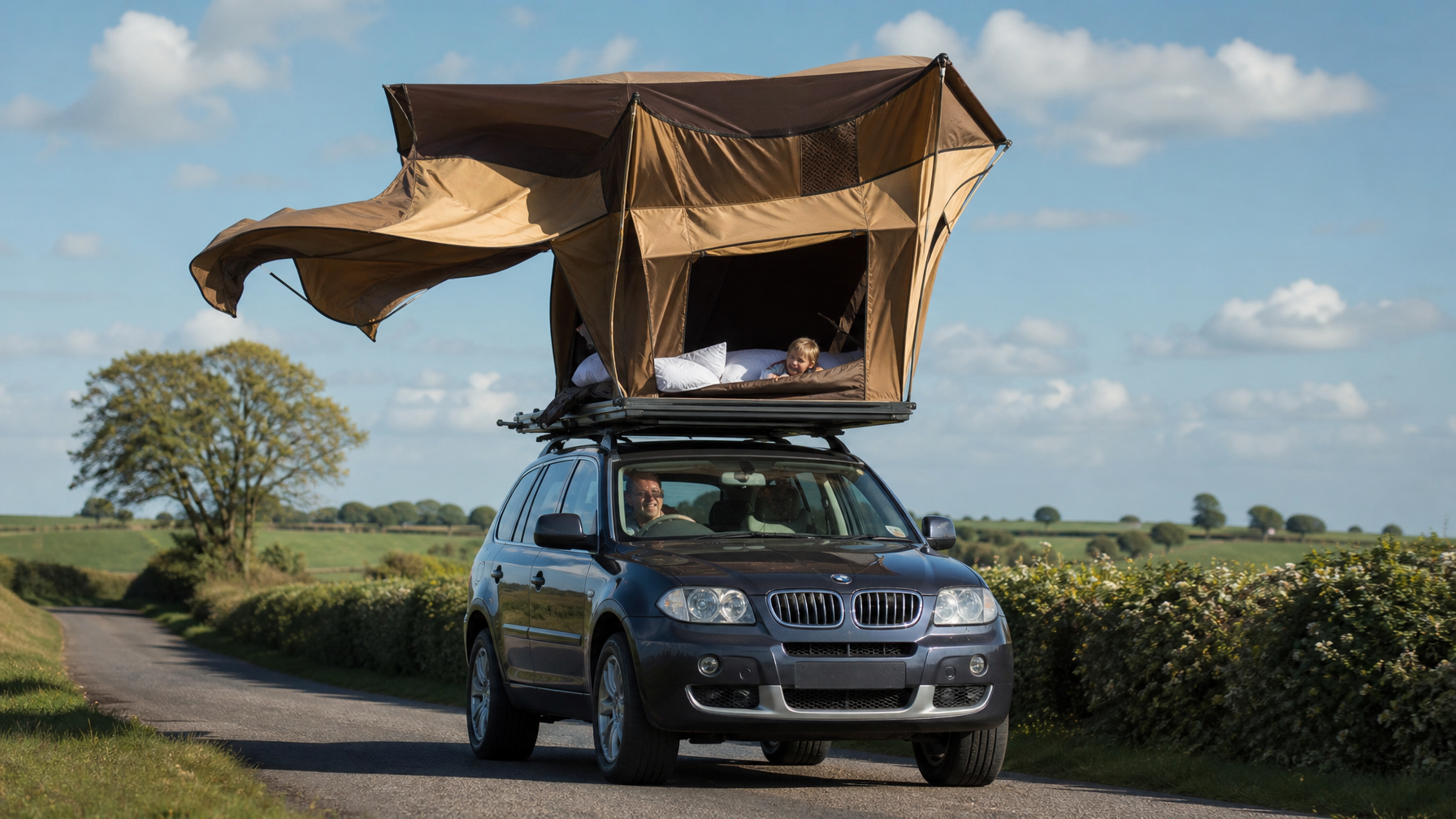
Always close and secure your roof tent before moving your vehicle. Always. Not to nip to the camp shop. Not to move to a better pitch. Not to drive home. Not ever. A roof tent left open at driving speed suffers catastrophic structural damage within seconds — and presents a serious hazard to every vehicle behind you. It is the single most common mistake first-time roof tent campers make, and it is entirely avoidable. Close the tent, secure the straps, then start the engine. In that order. Every single time.
7 Beginner Mistakes — and How to Avoid Every One
Not all campers get it right on the first trip. Here are the seven mistakes that catch out almost every first-time roof tent camper.
Mistake 1: Driving with the tent open
The big one. Whether it is a quick move to a better pitch or a full motorway run with the bedroom still deployed, the result is the same: a destroyed tent, a very embarrassing roadside stop, and a story you will tell for the rest of your life. Make “tent down before engine on” an unbreakable personal rule from day one.
Mistake 2: Forgetting about height restrictions
Even a closed roof tent adds 25–40cm to your vehicle height. Multi-storey car parks, drive-throughs, low bridges, and petrol station canopies all become obstacles. Check your car-plus-tent height before every urban stop. Many owners stick a note inside the driver’s door: “TENT ON — EXTRA HEIGHT.”
Mistake 3: Not checking the roof load rating first
Every car has a maximum dynamic roof load. Exceed it and you risk damaging the car body, voiding your warranty, and — in extreme cases — roof bars detaching at speed. Find your car’s rating in the handbook before purchasing any roof tent.
Mistake 4: Expecting to use the car freely once pitched
The moment your roof tent is open, your car is parked for the duration. You cannot nip to the shop, drive the dog to the beach, or move pitches without packing the entire tent away first. Arrive with everything you need for the evening, or use a bicycle or your feet once you are set up.
Mistake 5: Skipping the home practice run
First-time setups always take longer than expected. The straps are in unfamiliar places, the ladder angle is slightly off, and the flysheet clips are somewhere new every time. Practice in the driveway in daylight before your first trip. You will thank yourself at 7pm on a Norfolk campsite in the rain.
Mistake 6: Packing away with damp bedding inside
After a dewy Norfolk morning, your sleeping bag and mattress topper carry moisture. Closing the tent with damp bedding inside and leaving it a week until your next trip is a reliable route to a mould problem. Air everything out before packing away, or carry bedding separately in a dry bag.
Mistake 7: Parking on a slope without levellers
A gentle slope that looks perfectly fine from outside translates to a slow, steady midnight slide to one end of the mattress. Wheel levellers — small ramps you drive onto — sort this completely. Budget around £20–£40 for a set. Worth every penny on your first uneven pitch.
Top UK Roof Tent Brands in 2026
TentBox (UK) — Best for First-Timers
TentBox is the most popular roof tent brand in the UK and is British. Their range covers everything from the compact TentBox Lite (fits a Fiat Panda) to the spacious TentBox Lite XL (four-berth). Well made, good warranty support, and the most helpful owner community of any UK brand. Prices from around £899. tentbox.com
RoofBunk (UK) — Best for Speed
RoofBunk’s hardshell models are among the quickest to deploy on the UK market — “seconds, not minutes” is their pitch, and it is broadly accurate. Compatible with virtually any vehicle with roof bars. Camping and Caravanning Club members get a 10% discount.
Autohome (Italy) — Best Heritage Brand
Italian manufacturer Autohome has been making roof tents for over 60 years. They have vehicle-specific models for Mini and Land Rover, and their build quality is exceptional. Premium pricing reflects premium materials.
Thule (Sweden) — Best for Build Quality
Thule’s Approach range brings Scandinavian engineering to the roof tent market. Known for low-profile closed dimensions, excellent insulation, and some models sleeping up to four. Strong choice for year-round UK use. thule.com
Latitude (Somerset, UK) — Best British Alternative
Somerset-based Latitude makes three roof tent models with a focus on simple installation and versatility. Good mid-range option with a strong accessories range.
Front Runner by Dometic — Best for Overlanding
Born in South Africa, Front Runner tents are built for rough terrain. One of the lightest and lowest-profile hardshell options available. Excellent for anyone combining UK camping with European trips.
Roof Tent Camping with Dogs
Dogs and roof tents work — but needs a plan. The ladder is the main challenge. Most dogs will not climb an aluminium ladder four feet off the ground unaided. Practical solutions used by UK roof tent dog owners include:
- A separate ground tent or dog bed under the car — popular for larger dogs comfortable sleeping below while you sleep above.
- A dog-specific ladder ramp — a wider, less steep ramp fitted alongside the standard ladder, available from specialist retailers.
- Lift and carry — for smaller dogs, simply lift them to the tent entrance. Most accept this immediately and sleep beautifully once inside.
- A large four-berth softshell — the extra internal space gives everyone room to spread out comfortably, dog included.
All mYminiBreak campsites in Norfolk, UK are 100% dog-friendly — dogs on pitches, dogs on walks, dogs very much welcome. Whether your dog camps below the car or in the tent with you, there is always room.
Roof Tent Camping in North Norfolk, UK
Dog-friendly pitches near the coast, the Broads, and Thetford Forest — all with room for your car, your roof tent, and the dog who categorically refuses to climb the ladder. Book in as a campervan.
How to Book a Campsite Pitch for a Roof Tent
Book as a campervan — not a tent pitch. This is the rule, not a suggestion.
A roof tent means your vehicle is your accommodation. The roof rack and tent are fixed to the car, the car cannot move once the tent is pitched, and you will almost always be allocated a campervan pitch space anyway — so book it correctly from the start. A campervan pitch gives you the right space and clearance around the vehicle, and access to an electric hookup point if you want one for a lamp, phone charger, or morning kettle.
At all mYminiBreak campsites in Norfolk, UK: select campervan when booking, mention roof tent on arrival. We will show you to a pitch with the right space. No electric hookup is needed for the tent itself — roof tent camping is entirely self-contained — but EHU is there if you want it.
Where to Stay: Roof Tent Pitches in Norfolk, UK
🏕️ Hunstanton Camping & Glamping
Quiet, dog-friendly campervan pitches near Holme Beach — less than 5 minutes from the sea. Ideal for a roof tent coastal sunrise. Book as a campervan.
🌊 Holme-next-the-Sea Camping
Unspoilt coastal camping at one of the quietest beaches on the Norfolk coast. RSPB Titchwell Marsh nearby. Perfect for a roof tent sunrise over the salt marshes.
🌲 Holt Woodland Lakeside Camping
Woodland and lakeside camping near Holt. A roof tent in the trees on a still evening — with owls, not seagulls, as your soundtrack. Dog-friendly throughout.
🌳 Thetford Forest Camping
Forest camping in South Norfolk — Go Ape on the doorstep, miles of mountain bike trails, and a roof tent in the pines. The ideal adventure weekend base.
Also worth reading: Camping in a Tesla in the UK: The Complete 2026 Guide — if your car camping comes with Camp Mode, a virtual campfire on the dashboard, and climate control, that article is written for you.
Ready to try roof tent camping in Norfolk, UK?
Four dog-friendly campsites, coast to forest. Book in as a campervan, arrive with the tent closed, and we will do the rest. We look forward to seeing you — and your dog — up there.
Frequently Asked Questions
Can you drive with a roof tent on the car?
Yes — but only when the tent is fully closed and secured. A closed roof tent travels fine on any car with suitable roof bars, within the vehicle’s dynamic roof load rating. You must never drive with the tent open, even for a short distance. An open roof tent at driving speed sustains immediate structural damage and creates a serious hazard for other road users.
What is the difference between a hardshell and softshell roof tent?
A hardshell roof tent has a rigid outer casing that hinges open like a clamshell in roughly 60 seconds. It is quicker to deploy, more expensive, and has a lower closed profile on the road. A softshell tent unfolds by hand like a traditional tent — cheaper and more spacious, but takes 5–15 minutes to set up and pack away. Most UK beginners start with a TentBox hardshell for the convenience.
How do I book a campsite pitch for a roof tent?
Book as a campervan pitch, not a tent pitch. Your vehicle with a roof tent is your accommodation and the car cannot be moved once the tent is open — exactly like a campervan. The campervan pitch category gives you the right space and positioning. At all mYminiBreak campsites in Norfolk, UK, select campervan when booking and mention your roof tent on arrival.
Can dogs use a roof tent?
Yes, with a plan. The ladder is the main challenge — most dogs will not climb an aluminium ladder unaided. Solutions include a wider dog ramp, lifting smaller dogs directly into the tent entrance, or a separate dog bed on the ground below while you sleep above. All mYminiBreak sites in Norfolk are 100% dog-friendly across all pitches.
How much does a roof tent cost in the UK?
Budget softshell models start from around £400–£500. Mid-range softshells and entry-level hardshells sit at £700–£1,200. Premium hardshell models from TentBox, Thule, and Autohome range from £1,200 to over £3,000. You will also need suitable roof bars or a roof rack (£100–£400 depending on vehicle) if not already fitted.
Is a roof tent worth it for UK camping?
For most car campers who want a fast, comfortable setup without the hassle of ground tents, yes. The main advantages: no wet groundsheets, no searching for flat ground, faster setup than any traditional tent, and a significantly better view. The main trade-off: you cannot use the car freely once the tent is open, and the initial cost is higher than a comparable ground tent. For anyone camping more than six nights a year, the investment pays for itself quickly in comfort and convenience.
All mYminiBreak Accommodation & Sites
Three locations across North Norfolk, UK. Six accommodation types. All dog-friendly. Book directly — no booking fees.
Coastal Cottages
The Old Barn and The Dairy — self-catering holiday cottages near Hunstanton. Dog-friendly, Coast Path on the doorstep. Gift vouchers from £450.
Short Stays
B&B rooms, self-catering rooms, shepherd huts and The Stables chalets near Hunstanton. From one night. Gift vouchers from £221.
Glamping
Shepherd huts, yurt and bell tents at Holt woodland and Hunstanton coast. Fire pits, year-round, dogs welcome. Gift vouchers from £95.
Camping — Hunstanton
Coastal campsite near Hunstanton. Tents, campervans and motorhomes welcome. Sandringham 10 minutes away.
Camping — Holme-next-the-Sea
Pitches directly on the Norfolk Coast Path. Year-round dog beach. Wild Ken Hill and RSPB Titchwell within easy reach.
Camping — Holt Woodland
Lakeside camping in ancient woodland near Holt, 12 miles from the Cromer coast. Dogs welcome.
Check Availability
Cottages, glamping, short stays and camping pitches. All dog-friendly. No third-party fees.
Leave a Reply