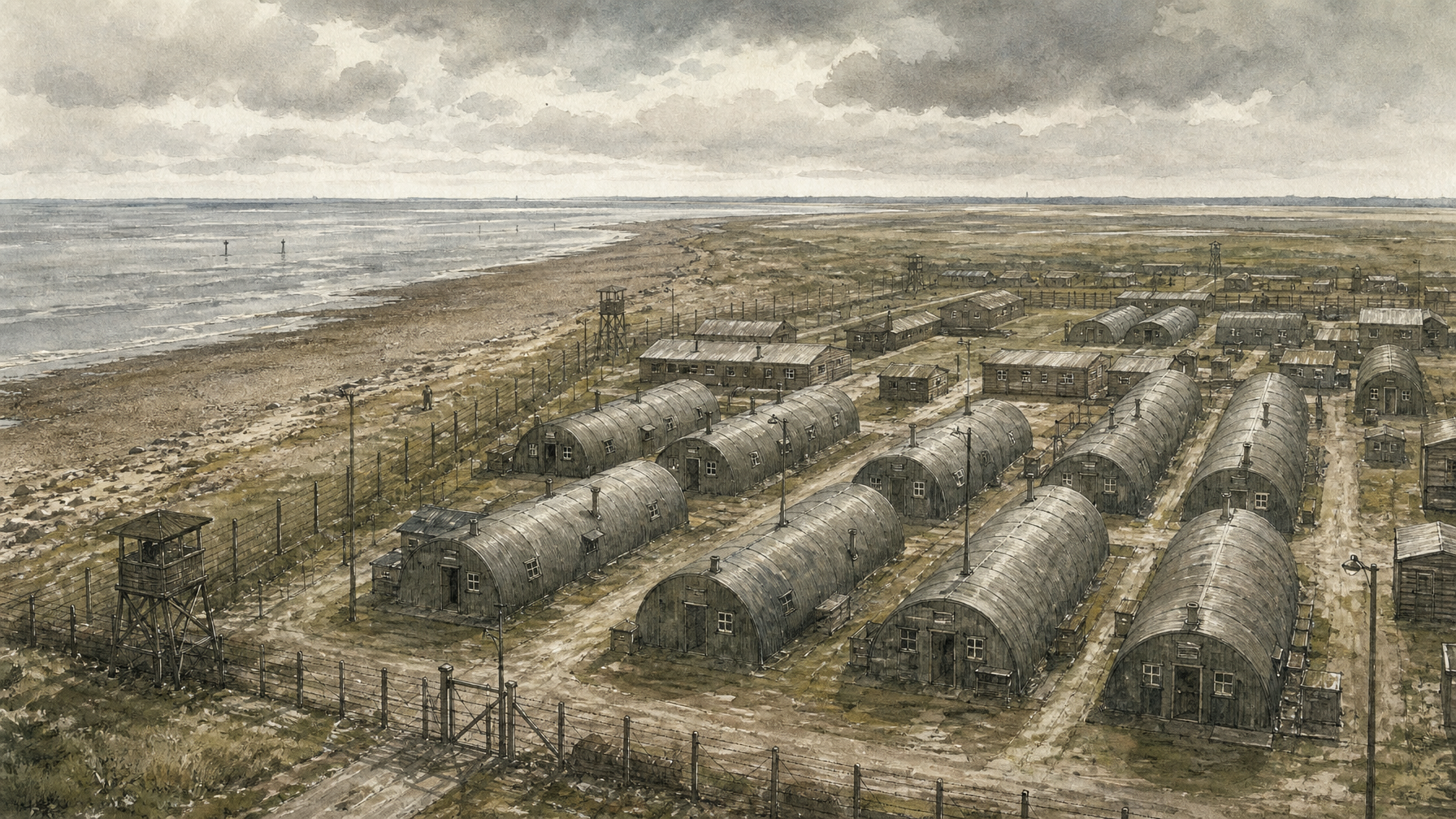
Camp 255: The Second World War Prisoner of War Camp at Snettisham
Behind the shingle banks at Snettisham Scalp, where holiday caravans now sit facing the Wash, there was once a prisoner of war camp. Italian and German prisoners lived and worked here in the 1940s. American aircrews trained overhead. The landscape they all moved through — the lagoons, the pits, the coastal edge — was being physically reshaped by their presence. Some of that reshaping is still visible today, if you know where to look.
Camp 255 is one of those pieces of wartime Norfolk that has been almost entirely absorbed back into the land. It does not appear on visitor maps. There is no information board. But it is recorded in the Historic England Research Records and the Norfolk Historic Environment Record, and it belongs to one of the most layered stretches of coastline in the county.
At a Glance
- Official designation — Prisoner of War Camp No. 255, “RAF Camp, Snettisham Scalp, Snettisham”
- Held — Italian and German prisoners of war, from c.1943 to c.1947–48
- Associated with — RAF coastal gunnery range; later the 8th USAAF Provisional Gunnery School
- Location today — beneath and adjacent to Snettisham Beach holiday and caravan parks
- Heritage records — Historic England Research Records; Norfolk Historic Environment Record
- The lagoons — the pits now used by RSPB Snettisham nature reserve were partly created by POW labour
Before the Camp: A Coastal Gunnery Range
Snettisham Scalp was drawn into Britain’s military network before the first prisoner of war hut was erected. In the early years of the war, the site was developed as an RAF combined gunnery range. The open shoreline and the isolation of the tidal flats made it well suited for live firing with safe arcs out over the Wash. Earthwork enclosures, concrete structures, and weapons emplacements were built along the beach, creating a self-contained military zone that bore little resemblance to the quiet coastal strip it had been before.
In 1943 the range passed to the United States Army Air Forces and became the 8th Air Force Provisional Gunnery School. American aircrews based across East Anglia came to Snettisham to train in air-to-ground and air-to-air firing techniques, using the Wash as a natural backstop. The site became one of several East Anglian locations where the Anglo-American air war was written directly into the landscape — hardstandings, observation posts, target markers on the shingle.
The Prisoner of War Camp
Within this military setting, part of the Snettisham Scalp complex was adapted to serve as Camp 255. The official record describes it as a working camp: prisoners were not held solely within the wire but were deployed daily as labour across the local area. Farms, construction sites, airfield projects — the manpower shortage in wartime West Norfolk was acute, and the prisoners helped fill it.
Contemporary accounts place the main camp buildings in the area now occupied by Snettisham Beach holiday and caravan parks, close to the present-day facilities. The physical layout would have been recognisable at any wartime camp of this type: rows of Nissen or timber huts, perimeter fencing, a gatehouse, guard posts, a cookhouse, ablutions blocks. Most of these structures were temporary and were dismantled after the war, leaving the ground largely clear for what came next.
The Labour That Shaped the Land
One detail in the local record stands out above the rest. Prisoners from Camp 255 were involved in excavating large quantities of shingle and aggregate for concrete — material used primarily in the construction of runways and hardstandings at nearby airfields. That excavation work enlarged and deepened the pits and hollows behind the beach.
Those pits are now the lagoons at RSPB Snettisham.
— mYminiBreak, from the Snettisham coastal walk
It is an unlikely chain of consequence. Prisoners of war dig shingle for airfield concrete. The pits they leave behind fill with water. The water attracts waders. Decades later, those same pits become one of the most important intertidal wildlife sites in England, hosting the Snettisham Spectacular — one of the UK’s greatest wildlife events, where up to 300,000 knot waders murmur off the mudflats in a single aerial display.
The Prisoners: Italian and German
Camp 255 held both Italian and German prisoners at different points. This reflected a wider pattern across East Anglia, where camp populations shifted as the war progressed and its outcome became clearer. Italian prisoners, following Italy’s armistice in September 1943, were often reclassified as co-operators and given somewhat greater freedoms. German prisoners, arriving in larger numbers after D-Day, remained under closer supervision until the war’s end.
The working-camp model meant that prisoners moved through the local landscape daily under guard — into farm fields, onto building sites, along the roads and tracks of West Norfolk. Over time, particularly in the later years, some contact between prisoners and local civilians became less formal. This pattern is documented anecdotally across East Anglia, where prisoners working on farms or in villages were sometimes remembered as individuals rather than as abstract enemies by the communities they passed through.
German prisoners may have remained at Snettisham as late as 1947 or 1948, continuing to provide labour in agriculture and reconstruction long after the fighting stopped. Demobilisation and repatriation took time across all British camps.
The Gunnery Range and the Aircrews
While prisoners worked the land, American aircrews came to the beach to practise killing. The 8th Air Force Provisional Gunnery School at Snettisham Scalp trained crews in air-to-ground firing techniques using live ammunition over the Wash. The same strip of coast that held barbed wire and prisoner huts also held observation posts, target structures, and the noise of low-flying aircraft on firing runs.
Surviving concrete elements of the wider gunnery range complex — bases, emplacements, fragments on or near the foreshore — remain visible to those who know what they are looking at. They connect the site directly to the story of the air war over East Anglia, a theatre that involved hundreds of thousands of American and British personnel and produced some of the highest casualty rates of the entire conflict.
From Military Land to Holiday Coast
Once the camp was vacated and the gunnery range decommissioned, the land at Snettisham Scalp went through the slow process of clearance, munitions removal, and rehabilitation. The temporary buildings came down. The fencing came out. The ground was tidied.
The Cycle of Land Use at Snettisham Scalp
- Pre-war — coastal leisure. A holiday camp on the Wash shoreline.
- Early war — RAF coastal gunnery range. Live firing over the Wash.
- 1943 onwards — 8th USAAF Provisional Gunnery School. American aircrews training.
- 1943 to 1947/48 — POW Camp 255. Italian and German prisoners. Working camp.
- Post-war — clearance and rehabilitation. Buildings removed, land returned.
- Present day — Snettisham Beach holiday and caravan parks on the former camp footprint. RSPB Snettisham on the former excavation pits.
One study of POW sites in eastern England noted that Snettisham had moved “from a Holiday Camp, to a Military Camp, to a PoW Camp, and back to a Holiday Camp and site once again.” It is a cycle that took less than fifteen years from first requisition to final handover — but the physical traces of what happened in between remain in the ground, in the lagoons, and in the records.
The Heritage Record
Camp 255 does not hold individual statutory designation, but it is recorded in the Historic England Research Records and the Norfolk Historic Environment Record as part of the wider Snettisham Scalp military complex. Sub-surface remains, surviving concrete structures near the foreshore, and an extensive documentary and aerial photographic record make the site one of the better-evidenced former POW camps in the region, even where surface features have been lost.
Historic England’s thematic survey of Second World War prisoner of war camps from 1939 to 1948 includes Snettisham within the national picture of working camps, labour deployment, and the integration of POW populations into the rural wartime economy.
Walk Through This History
Guests staying at our Heacham glamping site can walk the King Charles III England Coast Path from the pitch to RSPB Snettisham — passing the Camp 255 site en route. The lagoons the birds gather on today are the same pits that prisoners helped excavate. Our full RSPB Snettisham visitor guide covers the walk, the reserve, and where to stay.
Stay Near Snettisham — Five Minutes from the Reserve
Glamping pitches and shepherd huts at our Heacham site, directly connected to the coast path walk through this history.
Questions About Camp 255 and Snettisham’s Wartime History
Where exactly was Camp 255 located at Snettisham?
Contemporary accounts and post-war studies place Camp 255 in the area now occupied by Snettisham Beach holiday and caravan parks on Snettisham Scalp. The camp’s official designation was “RAF Camp, Snettisham Scalp, Snettisham.” Most surface structures were dismantled after the war, but sub-surface remains, documentary records, and aerial photography evidence the camp’s footprint in the Historic England Research Records and the Norfolk Historic Environment Record.
What nationalities of prisoner were held at Camp 255?
Camp 255 held both Italian and German prisoners at different points, reflecting the wider pattern across East Anglian camps as the war progressed. Italian prisoners began arriving from 1943 following Italy’s armistice. German prisoners came in larger numbers after D-Day in 1944. Some German prisoners may have remained at Snettisham into 1947 or 1948, continuing agricultural and reconstruction work after the war ended.
Did the prisoners create the lagoons at RSPB Snettisham?
This is one of the most striking aspects of the site’s history. Local records indicate that prisoners from Camp 255 were involved in excavating large quantities of shingle and aggregate for concrete, particularly for the construction of runways and hardstandings at nearby airfields. That excavation work enlarged the pits and hollows behind the beach. Those pits subsequently filled with water and became the lagoons that form the core of RSPB Snettisham nature reserve today — the same water bodies from which the Snettisham Spectacular knot murmurations are watched each autumn and winter.
What was the 8th Air Force gunnery school at Snettisham?
In 1943 the RAF coastal gunnery range at Snettisham Scalp was transferred to the United States Army Air Forces and became the 8th Air Force Provisional Gunnery School. American aircrews based across East Anglia came here to train in air-to-ground and air-to-air firing techniques, using the open Wash as a firing range. The site formed part of a wider network of Anglo-American training facilities across East Anglia during the Second World War. Surviving concrete structures near the foreshore are remnants of this period.
Can you still see any evidence of Camp 255 today?
The main camp buildings were dismantled after the war and the land was returned to civilian use. At surface level, the former camp site is now largely occupied by Snettisham Beach holiday and caravan parks. However, sub-surface remains are recorded in the Norfolk Historic Environment Record, and concrete structures from the wider gunnery range complex survive near the foreshore. The most visible legacy is the landscape itself — the lagoons at RSPB Snettisham, whose present form was partly shaped by the excavation work carried out by the prisoners.
Leave a Reply